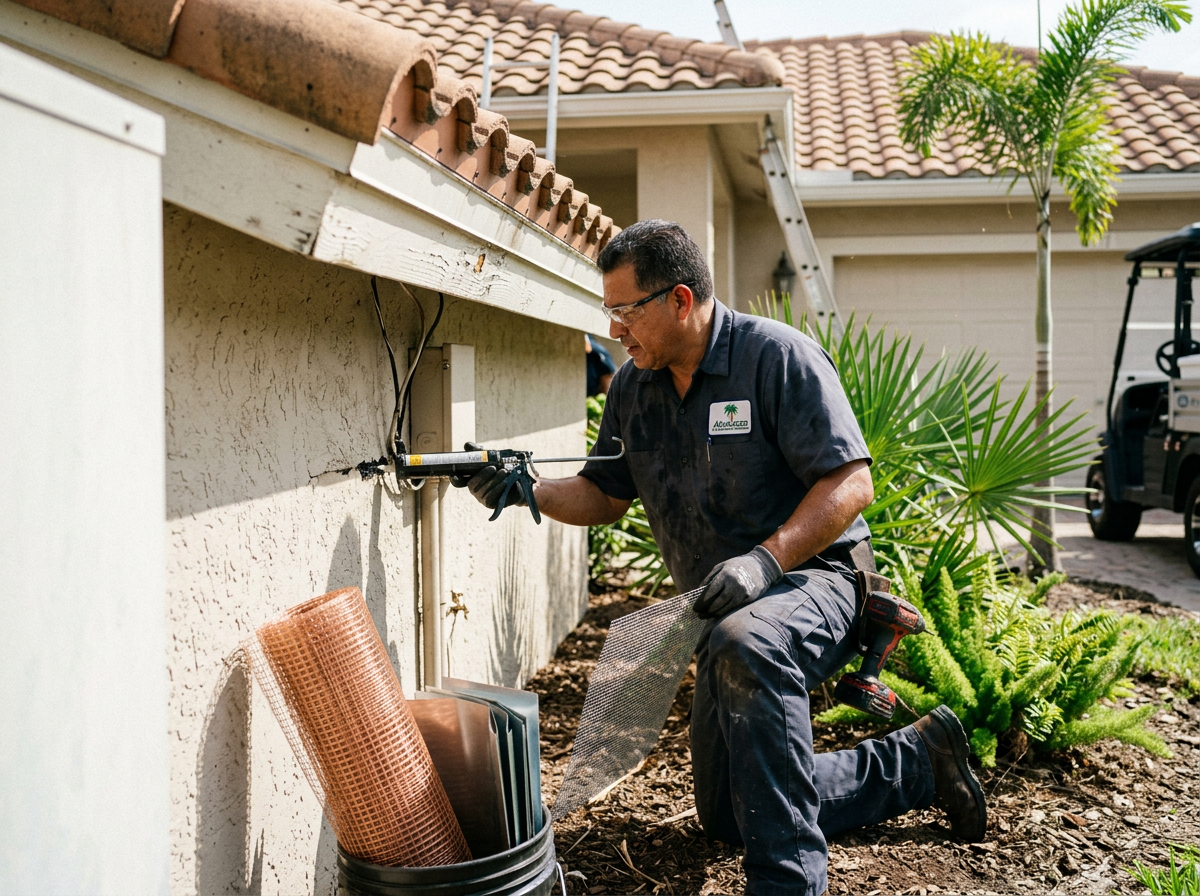
Roof rats reach Florida attics by traveling through oak canopies and palm fronds that touch the roof edge, then slipping into soffit gaps, fascia separations, barrel-tile voids, plumbing vent boots, gable vents, and AC line penetrations. Because there is no winter die-off, any unsealed opening lets new rats move in within days of trapping. Exclusion work therefore starts with a full roofline inspection that maps every possible overhead route before any material is installed.
Effective sealing uses steel mesh or hardware cloth secured behind a bead of sealant rather than expanding foam, which roof rats chew through in hours. Soffit and fascia sections are repaired or replaced where wood has rotted or pulled away, and vent boots receive custom collars that clamp tightly around pipes. Jobs fail when crews skip the tree-trimming step or leave even a quarter-inch gap around a return eave, allowing continued access from the canopy.
Rodent Exclusion and Sealing Near You — Choose Your City
Every city below has its own local Rodent Exclusion and Sealing page with coverage details.
Polk
Volusia
Polk County
Levy
Alachua County
Marion County
Lake
Columbia County
Lee
Sumter
Alachua
Clay County
Nassau
Orange County
Brevard County
St. Johns
Lafayette
Collier County
Pasco County
Lake County
Putnam
Seminole
Volusia County
Gilchrist County
Hendry County
Citrus County
Monroe County
Marion
Highlands
Union County
Citrus
Pasco
Sumter County
Orange
Bradford
Suwannee County
Attic heat accelerates odor issues when a rat dies inside a wall, so verification after sealing includes a final walkthrough with a flashlight to confirm no new activity before the job is closed. In Bartow neighborhoods with older housing stock, fascia boards often hide multiple hidden gaps that only become visible once gutters are removed during the repair process.
Technician insight
In Bartow the thing that catches most people out with Rodent Exclusion and Sealing is the heavy oak canopy that touches almost every roofline; homeowners seal the house but leave the trees untouched and the rats simply walk back across the branches within a week.
Bartow Roofline Access
Roof rats were entering an older Bartow home through gaps behind the fascia where palm fronds brushed the roof. Inspection showed multiple soffit openings and chewed vent boots. Steel mesh and collars were installed after trimming back the palms, and a follow-up check confirmed no further activity.
Rodent Exclusion and Sealing Services We Offer
✓Soffit and Fascia Repair
Damaged or separated soffit panels and fascia boards are replaced or secured to close the most common roof rat pathways along the roof edge.
✓Steel Mesh and Hardware Cloth Sealing
Galvanized steel mesh and hardware cloth are fastened over openings and backed with sealant that roof rats cannot chew through, replacing foam that fails quickly in Florida heat.
✓Vent and Pipe Boot Collars
Custom collars are fitted around plumbing vents and AC lines to eliminate gaps that roof rats use to drop directly into attics.
✓Garage Door Seal Replacement
Worn bottom seals and side weatherstripping on garage doors are replaced to stop ground-level entry that often connects to interior walls.
✓Roof Return and Eave Sealing
Returns and open eaves receive mesh barriers and sealant to block the continuous canopy routes roof rats follow from nearby trees.
How it works
- 1
Roofline and Perimeter Inspection
Technicians walk the entire roof edge, examine soffits, fascia, vents, and nearby trees to locate every overhead entry point used by roof rats.
- 2
Material Selection and Preparation
Steel mesh, hardware cloth, and appropriate sealants are chosen based on the size and location of each opening; foam is avoided.
- 3
Installation of Barriers
Mesh and collars are secured behind sealant, soffit and fascia repairs are completed, and all gaps are closed from the exterior.
- 4
Verification Walkthrough
A final attic and exterior check confirms no new activity and that every identified opening has been addressed before the job is marked complete.
Pricing
Scope depends on roof height, number of entry points, and extent of fascia or soffit repairs; pricing follows inspection—call to schedule.